What is biotin 5000 µg in mg?
Short answer
Biotin 5000 µg equals 5 mg. On a supplement label, that is the declared amount per serving, and it is far above ordinary adult reference intakes. The front-of-pack number shows quantity, not whether the product is better or more suitable for you.
Quick facts
- 5000 µg equals 5 mg.
- EFSA adult adequate intake is 40 µg per day.
- US adult adequate intake is 30 µg per day.
- Check the serving size and ingredient list, not just the front label.
- Biotin can interfere with some laboratory tests.
- Food sources mentioned include beef liver, eggs, salmon, and sunflower seeds.

What does biotin 5000 µg mean in mg?
Converting the label
5000 µg equals 5 mg. Micrograms, often written as “µg” or “mcg”, and milligrams are just different units for the same thing: amount. The conversion is simple arithmetic, not a claim of potency. On a supplement label, 5000 µg tells you how much biotin is declared in the stated serving, but it does not tell you whether the product is better, stronger, or more suitable for a particular goal.
Biotin is a water-soluble vitamin B7 (PMC article on biotin). In that context, 5 mg is a high-strength supplement amount when compared with daily reference intakes for adults. EFSA’s adult adequate intake is 40 µg/day, and the U.S. adult adequate intake is 30 µg/day (EFSA dietary reference values summary, NIH ODS biotin fact sheet).
How large is 5 mg compared with daily reference values?
| Benchmark | Amount | What 5000 µg equals |
|---|---|---|
| Biotin supplement label | 5000 µg | 5 mg |
| EFSA adult adequate intake | 40 µg/day | 125 times lower than 5000 µg |
| U.S. adult adequate intake | 30 µg/day | about 167 times lower than 5000 µg |
That scale helps readers understand the size of the dose, not its effect. EFSA explains that an adequate intake is used when evidence is not sufficient to set a more precise requirement; it is a reference point, not a treatment dose or a guarantee of any result. A 5 mg product therefore sits far above ordinary daily reference values, but the number on the front of the pack does not prove any benefit for hair, skin, or nails.
5000 µg tells you the amount in the stated serving; it does not tell you what the supplement will do.
What buyers should check next
The safest way to read a 5000 µg label is to pair the front-of-pack number with the serving instructions and the ingredient list. If the serving is one tablet or capsule, the amount is per unit; if it is a daily serving, the amount may refer to more than one unit. Either way, the headline number is about quantity, while the rest of the label tells you the product format and composition.
How does biotin work, and what claims are allowed?
Biotin is a water-soluble B vitamin that acts as a cofactor for five carboxylase enzymes involved in fatty-acid, glucose and amino-acid metabolism. That is the biological basis for the vitamin’s place in authorised claim wording about normal metabolism, rather than a promise of a visible result for every buyer. NIH Office of Dietary Supplements biotin fact sheet
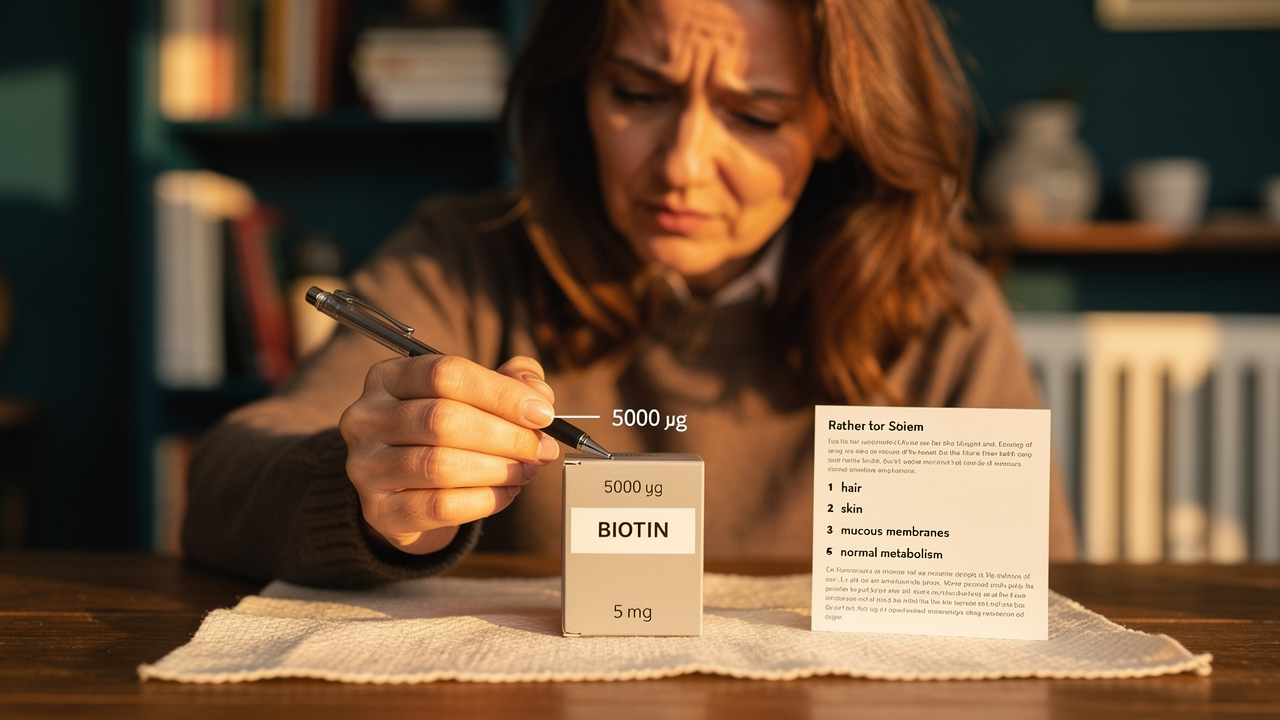
What biotin does in the body
It does not turn a nutrient statement into a disease-treatment claim. ODS biotin fact sheet
| Claim area | Authorised EU wording |
|---|---|
| Nervous system | |
| Macronutrient metabolism | |
| Psychological function | |
| Hair, mucous membranes and skin |
What the authorised wording allows
These are the main authorised EU claims, and they are permitted only under the applicable rules when the food is at least a source of biotin. They describe normal function; they do not authorise disease claims or a guarantee that a supplement will deliver a cosmetic outcome in every person. EU authorised biotin health claims
For shoppers, the practical mistake to avoid is reading claim language as if it were proof of performance. EUR-Lex Regulation (EU) No 432/2012
Who actually needs a 5 mg biotin supplement?
Confirmed deficiency is the clearest reason
The strongest case for oral biotin is a documented deficiency, especially the rare inherited disorder biotinidase deficiency. The NIH Office of Dietary Supplements fact sheet identifies this as the clearest clinical situation for specialist-managed use, and it notes that early diagnosis matters because the condition can be serious if unrecognised. In that context, published cohorts have used doses such as 10 mg/day for profound deficiency and 5–10 mg/day for partial deficiency, which is very different from taking 5 mg simply because it is available over the counter.
Risk of low status is not the same as a reason for automatic 5 mg
Some groups are more likely to need assessment rather than a fixed supplement habit. ODS reports low plasma biotin in 15% of people with chronic alcoholism and marginal deficiency markers in at least a third of pregnant women; it also notes lower serum biotin in a study of 264 people with epilepsy who had long-term anticonvulsant use. None of those findings says that everyone in those groups should take 5 mg daily, and none shows that a higher dose is automatically better than a lower one.
| Group | What the evidence shows | Practical reading |
|---|---|---|
| Diagnosed biotinidase deficiency | In an Italian newborn-screening cohort, 37 children were followed; 5 had profound deficiency and 32 partial deficiency, and oral biotin began at diagnosis. | This is the clearest setting for specialist supervision. |
| Chronic alcohol exposure | ODS reports low plasma biotin in 15% of people with chronic alcoholism. | Assessment comes before any supplement choice. |
| Pregnancy or breastfeeding | ODS reports marginal deficiency markers in at least a third of pregnant women and an AI of 45 µg/day during lactation from EFSA. | A routine 5 mg dose is not the reference benchmark. |
| Long-term anticonvulsant use | In 264 people with epilepsy, serum biotin was lower than in controls. | Medication context matters more than dose size on a label. |
What a 5 mg purchase should not mean
A 5 mg product is not a signal that more intake will translate into visible change. The evidence base ODS summarises does not establish that biotin-sufficient adults need 5 mg every day, and a 2024 review found the better hair studies were limited and did not show clear benefit in healthy users. For that reason, 5 mg fits best as a need-based choice, not a beauty trend bought first and justified later.
5 mg makes sense when there is a real reason to use biotin; it is not a default dose for healthy adults.
For anyone considering a high-dose product, the practical first step is simple: look for a documented need, not a label promise. If the question is about a specific medical context, the dose, timing and product choice belong with the clinician who knows that context.
Does biotin 5000 µg help hair, skin and nails?
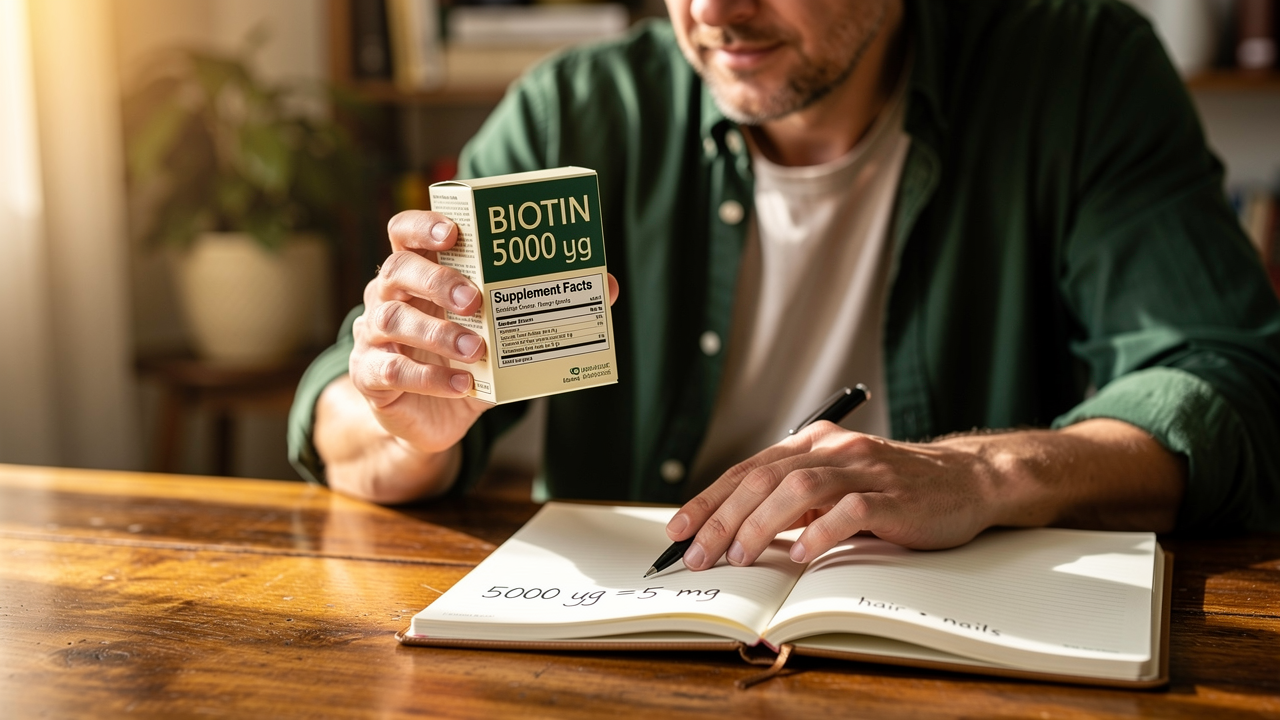
The evidence splits into two very different situations: correcting a genuine biotin deficiency, and taking 5 mg as a beauty supplement. The first is a medical context; the second has much weaker support. A 2024 review of biotin for hair loss found only three eligible studies after excluding case reports, and its strongest study was double-blind and placebo-controlled with no difference in hair growth between biotin and placebo. The NIH ODS biotin fact sheet describes the outside-deficiency evidence for hair, skin and nails as limited.
| Area | What was studied | What it does and does not show |
|---|---|---|
| Hair | Three eligible studies in the 2024 review; one placebo-controlled study found no difference, while the others involved isotretinoin use and post-sleeve gastrectomy patients. | These are specialised settings and do not establish a routine benefit for healthy adults taking 5,000 µg. PubMed review |
| Nails | Small uncontrolled studies used 2.5 mg/day; one reported a 25% thickness increase in eight patients after 6-15 months, while another 14-patient set did not show a significant thickness change. A later 50-person study added 10 mg/day biotin to nail lacquer. | Those designs cannot prove that biotin alone caused the changes or that 5 mg works better. NIH ODS |
| Skin | Earlier evidence mainly consisted of case reports in infants, using 100 µg to 10 mg/day in situations unlike routine adult skincare. | This does not establish a beauty benefit for otherwise healthy adults taking a standard 5 mg product. NIH ODS |
Hair: the best study did not separate biotin from placebo
For hair, the key point is not that evidence is mixed; it is that the best available study in the 2024 review did not show a measurable difference at all. The other studies in that review were not strong enough to generalise to ordinary consumers, because one involved people taking isotretinoin and another involved women after sleeve gastrectomy. That means a good-looking testimonial or before-and-after photo still sits below the standard of a controlled comparison. PubMed review
Nails: the timeline is months, not days
The nail data are older, smaller and mostly uncontrolled. In the ODS summary, the most concrete signal comes from paired nail measurements in eight patients, where thickness increased 25% after 6-15 months; another small set of 14 patients did not show a significant thickness change, and a retrospective report found improvement in 22 of 35 patients. A later 50-person study tested biotin only as an add-on to nail lacquer, not as a stand-alone comparison against placebo. If a person decides to try biotin anyway, the published nail studies suggest that any visible change would be assessed over months rather than in a few weeks. NIH ODS
Skin: case reports are not the same as robust evidence
Skin claims rest mostly on case reports in infants, not on strong adult trials. The ODS fact sheet notes doses from 100 µg to 10 mg/day in those reports, but those circumstances are unlike routine adult skincare. That is why small uncontrolled studies and personal testimonials should be treated as clues to explore, not proof that 5,000 µg changes skin appearance in biotin-sufficient adults. NIH ODS
An anecdote can be interesting, but it cannot show that biotin caused the result; the FDA says testimonials generally cannot substantiate a supplement-effect claim because change may be coincidental or due to another factor. FDA guidance
How much biotin do you need, and which foods provide it?
Reference intakes for adults
EFSA’s adult adequate intake for biotin is 40 µg/day; during lactation it is 45 µg/day. The NIH Office of Dietary Supplements lists a US adult AI of 30 µg/day and 35 µg/day during lactation (Biotin fact sheet). EFSA also notes that an AI is used when evidence is not enough to set a population reference intake, so it is a reference point rather than a treatment dose or an upper limit.
| Benchmark | Biotin amount | What 5,000 µg equals |
|---|---|---|
| EFSA adult AI | 40 µg/day | 125 times this amount |
| US adult AI | 30 µg/day | about 167 times this amount |
| EFSA lactation AI | 45 µg/day | about 111 times this amount |
| US lactation AI | 35 µg/day | about 143 times this amount |
5,000 µg is 5 mg of biotin, so it is far above ordinary dietary reference intakes even though those intakes are not upper limits.
Foods that contribute biotin
Biotin is present in many foods, including organ meats, egg yolk, some vegetables and cow’s milk. In the NIH food table, examples include 30.8 µg in a cooked 3-ounce serving of beef liver, 10.0 µg in one whole cooked egg, 5.0 µg in 3 ounces of pink salmon canned in water, and 2.6 µg in ¼ cup of roasted sunflower seeds (Biotin fact sheet). These figures are for the stated edible serving and preparation, not per 100 g.
Why the numbers change from one food to another
The measured amount can shift with food type, processing and preparation, and the NIH notes that USDA FoodData Central does not routinely list biotin content (Biotin fact sheet). Much dietary biotin may be protein-bound and must be released before absorption, while raw egg-white avidin can bind biotin and reduce absorption; cooking denatures avidin (Biotin fact sheet). For shoppers, the practical mistake is to treat a single database number as fixed: the same food can show a different value depending on how it was cooked or processed.
Which biotin form should you choose?
Start with the format, but read the label
FDA lists dietary supplements in several forms, including tablets, capsules, softgels, gel caps, liquids, gummies, powders and bars; the form tells you how the product is delivered, not how much biotin it contains. The decision point is the Supplement Facts panel, which must show the serving size, servings per container and the amount of each dietary ingredient per serving. FDA’s overview of dietary supplements also notes that labels are part of how these products are presented to buyers.
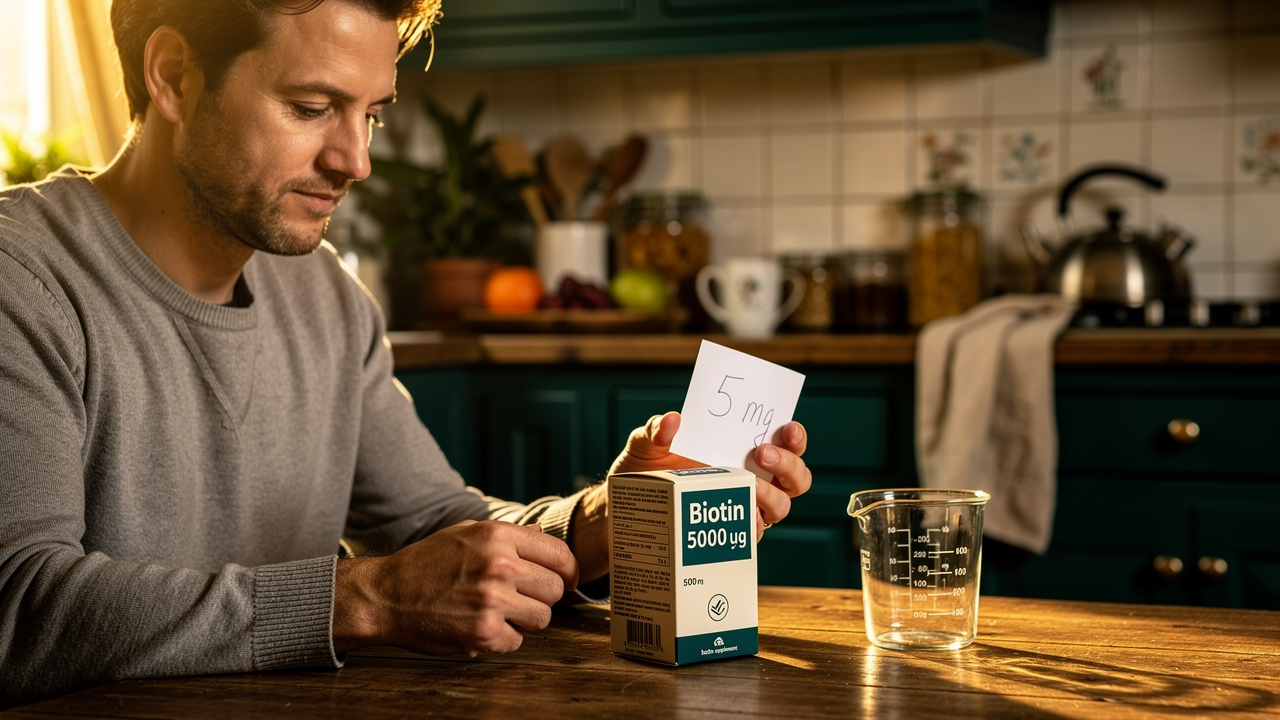
Read the whole label, not just “5000” on the front.
That matters because 5,000 µg can mean one tablet, several gummies or a measured volume of liquid, depending on the product directions. The package shape does not tell you the daily amount by itself.
What changes between capsules, tablets, gummies and liquids?
The biggest differences are practical: the format, the serving setup and the ingredient list. FDA guidance says to check whether the product supplies other vitamins, minerals or botanicals, and to inspect the ingredient list for sweeteners, flavors and colors if relevant. General dietary supplement labeling guidance also makes clear that a product name such as “hair, skin and nails” does not define the formula.
| Form | What the label tells you | What to verify |
|---|---|---|
| Tablets | Listed as a supplement form by FDA | Biotin per serving and directions for use |
| Capsules / softgels / gel caps | Listed as supplement forms by FDA | Serving size, number of servings, other ingredients |
| Gummies | Listed as a supplement form by FDA | Sweeteners, flavors, colors and the declared biotin amount |
| Liquids | Listed as a supplement form by FDA | Measured volume per serving and the daily directions |
The common buying mistake
One easy mistake is to assume a pleasant format is a better product. A gummy can look more appealing, but appeal is not a measure of dose, and a liquid is only useful if the measured serving is clear. The Finnish Food Authority advises online buyers to check the product’s composition before purchase and to make sure they can get enough information about what it is made from. Its online-shopping guidance also warns that information and claims can be misleading, so compare declared ingredients rather than the front-of-pack style.
Bottom line: choose the format you will actually use, then compare the declared biotin amount per serving, the daily directions and the ingredient list. The label determines the dose; the form mainly determines convenience and what else comes with it.
What side effects and interactions matter most?
Direct side effects: limited evidence of toxicity
NIH Office of Dietary Supplements biotin fact sheet FDA guidance on dietary-supplement claim substantiation
The main known interaction is with laboratory tests
Biotin can interfere with streptavidin/biotin-based immunoassays, producing falsely high or falsely low results. The NIH fact sheet names susceptible tests that include some thyroid hormones, TSH, 25-hydroxyvitamin D and cardiac markers, and it notes that the FDA continues to warn about troponin tests used in heart-attack assessment. In a study of 10 healthy adults who took 5 mg/day or 10 mg/day for seven days, 5 mg interfered with thyroid tests on two assay platforms for up to eight hours after dosing, while a third platform showed no interference. That makes the timing assay-specific rather than a universal eight-hour waiting rule. PMC study on biotin interference in thyroid function tests NIH Office of Dietary Supplements biotin fact sheet
The biggest safety issue with 5,000 μg biotin is not proven direct toxicity; it is the chance of misleading laboratory results on a susceptible assay.
Who needs extra caution
| Situation | What the evidence says | Practical takeaway |
|---|---|---|
| Thyroid or urgent cardiac testing | Some assays can be distorted, and 5 mg affected two thyroid-test platforms for up to eight hours in healthy adults | Tell the clinician and laboratory the dose and the time of the last dose before the sample is taken |
| Pregnancy or breastfeeding | NIH identifies these groups as more likely to have inadequate biotin status, and the 5 mg washout study excluded pregnant and lactating participants | Use clinician guidance rather than assuming the study timing applies |
| Children or kidney disease | The washout study enrolled only healthy adults with normal renal function | Do not extrapolate the 8-hour timing to these groups |
| Specialist care | Undisclosed biotin can affect interpretation of lab results that guide care | Mention biotin in advance rather than after an unexpected result |
NIH also lists people with diagnosed biotinidase deficiency and people with chronic alcohol exposure among groups that may have inadequate biotin status. None of that means a 5 mg supplement is automatically the right choice for them; it means the supplement should be discussed in context of the person, the assay and the reason for testing. NIH Office of Dietary Supplements biotin fact sheet PMC study on biotin interference in thyroid function tests
How useful are biotin 5000 µg reviews?
Consumer reviews are anecdotes, not proof. FDA guidance on substantiating dietary supplement claims NIH biotin fact sheet
What reviews can help with
Reviews are still useful for practical fit: taste, pill size, packaging, ease of swallowing, shipping, and whether the label is easy to understand. The Finnish Food Authority says feedback from other buyers can help when assessing an unfamiliar online seller, while also warning that businesses may join those discussions and promote their own products. Finnish Food Authority online-shopping checklist
| Review clue | Useful for | Not proof of |
|---|---|---|
| Taste and ease of swallowing | Whether the format suits daily use | Any biological effect |
| Pill size and packaging | Whether the product is practical to handle | Composition or quality control |
| Shipping and delivery comments | Whether the seller fulfils orders smoothly | Whether 5,000 µg was actually effective |
| Label photos and ingredient notes | Whether the bottle matches the listing | A guarantee that the label is correct |
Why before-and-after posts need scepticism
Be cautious with dramatic before-and-after claims that lack context: when the person started, how long they used the product, and whether the photos were taken under comparable conditions. Without that, a striking post is only a personal story. Reviews cannot show that biotin caused hair or nail changes, and they cannot verify that the product contains its declared amount. For that, check the actual label and any publicly available control information rather than star ratings alone. The FDA’s labelling guidance says U.S. dietary supplements carry serving size and ingredient amounts per serving, and the Finnish Food Authority says buyers should check the composition and the latest Oiva report where available. FDA dietary supplement labelling guide, Chapter IV FDA dietary supplement labelling guide, Chapter I Finnish Food Authority online-shopping checklist
Use the brand name as a search filter, not as evidence
A search such as Solgar biotin 5000 µg reviews can quickly narrow the field to the exact product you are considering. Treat it as a shortcut, then verify the label, serving size, ingredient list, and any third-party quality or control information instead of relying on star ratings alone. The FDA says label information matters, and the Finnish Food Authority says online buyers should be able to check the same essential food information they would see on the package, apart from date labelling. FDA dietary supplement labelling guide, Chapter IV Finnish Food Authority distance-selling labelling page
Reviews can help you choose a convenient product; they cannot prove composition, quality control, or a biological effect.
Safety and precautions
Biotin can interfere with some laboratory tests, including thyroid and cardiac markers, so tell your clinician and the laboratory about the dose and when you last took it before testing. Do not assume the timing is the same for every assay.
If you take medication, are pregnant or breastfeeding, or are considering biotin for a child, ask a healthcare professional before using a high-dose product. People with kidney disease or other specialist care needs should also get individual advice.
Supplements with the ingredients in this article
Compare contents, dose and price
Frequently asked questions
What does 5000 µg biotin mean?
It means the declared amount of biotin in the stated serving is 5000 micrograms. That is a unit measurement, not a statement about effect. On the label, it is the amount you are getting per serving or daily serving, depending on the instructions.
Is 5 mg a lot compared with daily reference values?
Yes. Five milligrams is far above the adult reference values mentioned in the body, which are measured in tens of micrograms per day. Those reference values are benchmarks, not treatment doses or guarantees of any result.
What should I check on the label before buying?
Look at the serving size, the number of servings per container, the amount of biotin per serving, and the full ingredient list. The package shape alone does not tell you the daily amount. It is also important to see whether the amount refers to one unit or several.
Can biotin affect blood tests?
Yes. Some tests can give misleading results if biotin is present, including certain thyroid and cardiac assays. Tell the clinician and the laboratory the dose and the time of your last dose before you have the sample taken.
Who should ask for advice before using biotin 5000 µg?
Anyone taking medication, pregnant or breastfeeding, considering it for a child, or living with kidney disease should get individual advice first. The same applies if you are having thyroid or urgent cardiac testing. A healthcare professional can help match the product and timing to the situation.
Sources
- Dietary Reference Values for nutrients Summary report (external link)
- Title of the Technical report (external link)
- EUR-Lex: EUR-Lex - 02012R0432-20160620 - EN (external link)
- Biotin - Health Professional Fact Sheet (external link)
- Biotin - Health Professional Fact Sheet (external link)
- Understanding Dietary Supplements (external link)
- FDA: Dietary Supplement Labeling Guide: Chapter IV. Nutrition Labeling (external link)
- FDA: Dietary Supplement Labeling Guide: Chapter I. General Dietary Supplement Labeling (external link)


