What Are the Main Sources of Zinc? Food, Absorption & Key Facts
Short answer
Oysters are the richest food source of zinc in the body’s comparison, but beef, cheese, pumpkin seeds, fortified breakfast cereal, whole wheat bread, lentils, and yogurt also contribute. How much zinc you absorb depends on the rest of the meal, especially phytate, and supplements should be compared by elemental zinc per serving.
Quick facts
- Eastern oysters provide about 32 mg of zinc per 3 oz.
- Beef bottom sirloin provides about 3.8 mg per 3 oz.
- Pumpkin seeds provide 2.2 mg per 1 oz serving.
- Fortified breakfast cereal provides about 2.8 mg per typical serving.
- Phytate lowers zinc availability and can change absorption a lot.
- Supplement labels list elemental zinc, not the full salt weight.

How much zinc do common foods contain?
The most useful comparison is the portion people actually eat. In the NIH Office of Dietary Supplements zinc fact sheet and the USDA National Nutrient Database for Zinc, oysters are the clear standout: Eastern oysters, raw, are listed at about 32 mg of zinc per 3 oz (85 g), or 37.6 mg per 100 g. Beef, bottom sirloin, roasted, is much lower at 3.8 mg per 3 oz and about 4.5 mg per 100 g.
Representative zinc amounts in normal servings
| Food | Representative serving | Zinc per serving | Zinc per 100 g |
|---|---|---|---|
| Eastern oysters, raw | 3 oz (85 g) | 32 mg | 37.6 mg |
| Beef, bottom sirloin, roasted | 3 oz (85 g) | 3.8 mg | 4.5 mg |
| Cheddar cheese, diced | 1 cup | 4.8 mg | 3.6 mg |
| Pumpkin seeds, roasted | 1 oz (28 g) | 2.2 mg | 7.9 mg |
| Lentils, boiled | 1/2 cup (~100 g) | 1.3 mg | 1.3 mg |
| Greek yogurt, plain | 6 oz (170 g) | 1.0 mg | 0.6 mg |
| Fortified breakfast cereal | Typical serving | about 2.8 mg | not specified |
| Whole wheat bread | 100 g | about 2.1 mg | about 2.1 mg |
| Chickpeas | not stated in the quoted figures | — | — |
| Oats | not stated in the quoted figures | — | — |
Pumpkin seeds show the opposite pattern: they are zinc-dense at 7.9 mg per 100 g, but a normal 1 oz serving still gives 2.2 mg. Fortified breakfast cereal is also useful because the serving already contains about 2.8 mg, even though the exact amount changes with the product and fortification level.
Why the same food can look stronger or weaker
These numbers are not fixed. The practical lesson is simple: use per-serving numbers for the plate, and per-100 g numbers for density.
Chickpeas and oats sit in the broader legume and grain groups that are recognized zinc sources, but the quoted figures here do not give one clean representative number for them, so it is better not to guess.
Why does zinc absorption differ by source?
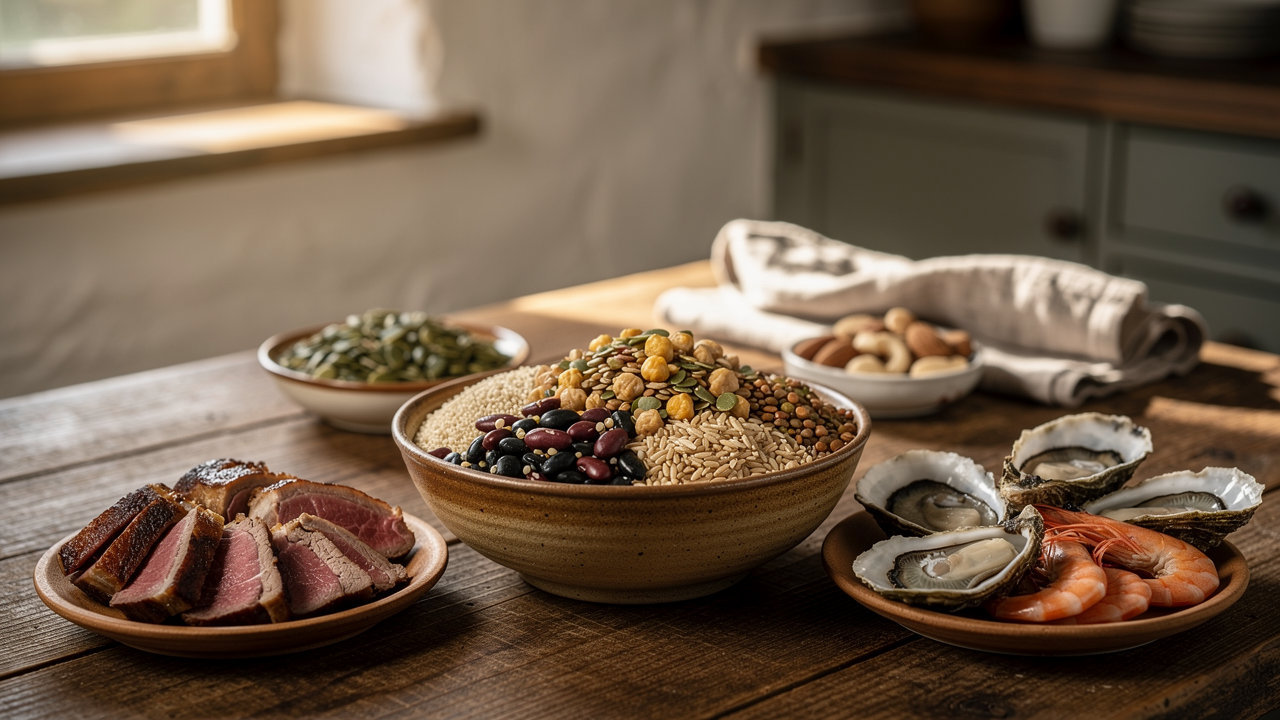
Zinc is absorbed differently depending on what it is eaten with. EFSA notes that most dietary zinc is absorbed in the upper small intestine, and that the contents of the duodenum and jejunum—especially phytate—can have a major effect on how much zinc is available for absorption (EFSA scientific opinion on dietary reference values for zinc). In the same opinion, EFSA describes absorption as homeostatically regulated: when intake is low, fractional absorption can rise; when intake is higher, the fraction absorbed falls. In diets low in phytate and low in zinc, the fraction absorbed may be as high as 60% or more, while absorption decreases progressively as dietary zinc intake rises (EFSA scientific opinion on dietary reference values for zinc).
Phytate is the main inhibitor
Phytate, found in many plant foods, binds zinc and reduces bioavailability. The evidence base behind zinc requirements shows that dietary zinc and phytate content account for more than 80% of the variability in absorbed zinc in modeling work (PubMed: Zinc bioavailability and homeostasis). EFSA classifies diets with a phytate:zinc molar ratio below 5 as high-absorption, while ratios above about 15 indicate low absorption efficiency; ratios between 5 and 15 are intermediate (EFSA scientific opinion on dietary reference values for zinc).
| Meal context | EFSA phytate:zinc ratio | Absorption pattern |
|---|---|---|
| Refined foods, low phytic acid, non-vegetable protein | Below 5 | High |
| Mixed diets with some animal or fish protein | 5 to 15 | Moderate |
| Unrefined cereals and other high-phytate staples with little animal protein | Above about 15 | Low |
The whole meal matters more than one food
The same amount of zinc can be more or less useful depending on the rest of the meal. EFSA states that the phytate content of the diet has a more profound effect on zinc availability than protein content, while the source and amount of protein still matter for absorption (EFSA scientific opinion on dietary reference values for zinc). Animal protein, peptides and amino acids have also been reported to enhance zinc bioavailability, and organic zinc complexes are better absorbed than inorganic salts in the supplement literature (PubMed: Dietary Zn—Recent advances in studies on bioaccessibility and bioavailability). A practical takeaway is that zinc-rich foods eaten with bran, whole grains, legumes, nuts or seeds may deliver less absorbable zinc than the same zinc amount in a lower-phytate meal.
Processing can reduce phytate
Food preparation can improve access to zinc. Human intervention evidence found that phytase supplementation or dephytinized foods improved zinc bioavailability in most studies, while high-phytate foods reduced it in most studies (PubMed: Dietary Phytic Acid, Dephytinization, and Phytase Supplementation Alter Trace Element Bioavailability). Controlled fermentation, including sourdough and legume fermentation, can degrade phytate, and sources in the evidence note that soaking and sprouting also reduce phytates (PubMed: Fermentation of food and feed; NIH ODS Zinc Health Professional Fact Sheet). Supplements are different: the label lists elemental zinc, and common forms include zinc sulfate, acetate, gluconate, citrate and oxide, rather than zinc packaged inside a phytate-rich food matrix (NIH ODS Zinc Health Professional Fact Sheet).
When you compare zinc sources, compare the whole meal, not just the zinc number on its own.
How much zinc do you need each day?
EFSA’s zinc numbers change with diet and life stage
EFSA does not give one fixed zinc target for every adult. In its 2014 Dietary Reference Values opinion, the Average Requirement for women ranges from 6.2 to 10.2 mg/day and for men from 7.5 to 12.7 mg/day, depending on phytate intake levels of 300, 600, 900, and 1,200 mg/day. The same opinion lists 11.8 mg/day for adolescent boys. EFSA Scientific Opinion on Dietary Reference Values for zinc
That life-stage approach matters because EFSA’s zinc requirements were modelled from absorption studies and then adjusted for dietary phytate. The opinion also states that it used reference body weights and a factorial approach, which is why the tables are not one-size-fits-all. EFSA Scientific Opinion on Dietary Reference Values for zinc
AR, PRI and UL are different kinds of numbers
In plain language, AR is the average requirement, PRI is the population reference intake, and UL is the upper limit. The EFSA upper-limit report says the UL is not a recommended intake; it is the highest intake judged unlikely to pose a risk of adverse effects. EFSA tolerable upper intake level report
NIH ODS uses a separate U.S. framework. Its consumer fact sheet notes that zinc needs are higher in pregnancy and lactation than in baseline adult life stages, and the health-professional fact sheet gives an adult UL of 40 mg/day from all sources. NIH ODS Zinc Consumer Fact Sheet NIH ODS Zinc Health Professional Fact Sheet
| Authority | Group | Figure in the retrieved sources | How to read it |
|---|---|---|---|
| EFSA | Adult women | AR 6.2–10.2 mg/day | Adjusted for phytate intake |
| EFSA | Adult men | AR 7.5–12.7 mg/day | Adjusted for phytate intake |
| EFSA | Adolescent boys | 11.8 mg/day | Life-stage specific value |
| NIH ODS | Adults | UL 40 mg/day | Safety ceiling, not a goal |
| NIH ODS | Pregnancy and lactation | Higher than baseline adult needs | Consumer fact sheet notes increased needs |
EFSA also states that it derived values for infants and children, but the excerpted lines here do not show their final age-by-age figures.
Takeaway: Treat zinc intakes as a range by age, sex, and diet pattern, and do not confuse a population reference intake with the upper limit.
Which zinc supplement forms are commonly used?
Start with elemental zinc, not the compound name
The NIH Office of Dietary Supplements zinc fact sheet says Supplement Facts panels list the amount of elemental zinc, not the full weight of the compound. That means a label such as “15 mg zinc (as zinc gluconate)” is telling you how much zinc is in the serving, not how much the whole salt weighs.
The same fact sheet names zinc sulfate, zinc acetate, and zinc gluconate as common label forms, and it compares absorption for zinc citrate and zinc oxide in young adults. On that basis, the first shopping check is the elemental amount per serving; the second is the serving size itself, because a larger capsule or tablet does not automatically mean more zinc.
What the label name can and cannot tell you
| Form named in the supplied sources | What the evidence here says | What shoppers should compare |
|---|---|---|
| Zinc gluconate | Listed by NIH as a common label form; reported at about 61% absorption in young adults: NIH ODS zinc health professional fact sheet | Elemental zinc per serving |
| Zinc citrate | Reported at about 61% absorption in young adults: NIH ODS zinc health professional fact sheet | Elemental zinc per serving |
| Zinc oxide | Reported at about 50% absorption in young adults: NIH ODS zinc health professional fact sheet | Elemental zinc per serving |
| Zinc sulfate | Listed by NIH as a common label form: NIH ODS zinc health professional fact sheet | Elemental zinc per serving |
| Zinc acetate | Listed by NIH as a common label form: NIH ODS zinc health professional fact sheet | Elemental zinc per serving |
Some PubMed-reviewed zinc complexes and amino-acid chelates are described as better absorbed than inorganic salts such as oxide or sulfate, but that does not turn one label name into a guarantee. The practical comparison still starts with the amount of elemental zinc and how the product is used.
Format, convenience, and a few checks that prevent mistakes
Those formats change convenience, not the rule that the Supplement Facts panel is built around elemental zinc per serving. A product that is easy to take is useful only if the serving size and daily-use instructions are clear enough to compare fairly.
One more label check is whether copper is listed. The NIH fact sheet notes that total zinc intakes of 50 mg/day or more for weeks can impair copper absorption, so shoppers comparing higher-zinc products should read the full ingredient panel carefully: NIH ODS zinc health professional fact sheet.
Form choice is mainly about elemental content, tolerability, and convenience; the compound name alone does not prove a product is better.
For a quick comparison, check four things in order: elemental zinc per serving, serving size, whether the product is meant for daily use, and whether copper is included. That keeps you focused on what the label actually says rather than on the weight of the zinc salt.
How can plant-based eaters cover zinc?
Vegetarians and vegans can get zinc from food, but the supplied evidence says they often need more planning because plant patterns tend to bring more phytate, and phytate is the main dietary inhibitor of zinc absorption. EFSA modelled adult zinc requirements by phytate intake: at 300 mg phytate per day, the population reference intake was 9.4 mg/day for men and 7.5 mg/day for women, rising to 16.3 mg/day and 12.7 mg/day at 1,200 mg phytate per day (EFSA scientific opinion; NIH consumer fact sheet).
Build around zinc-containing plant foods
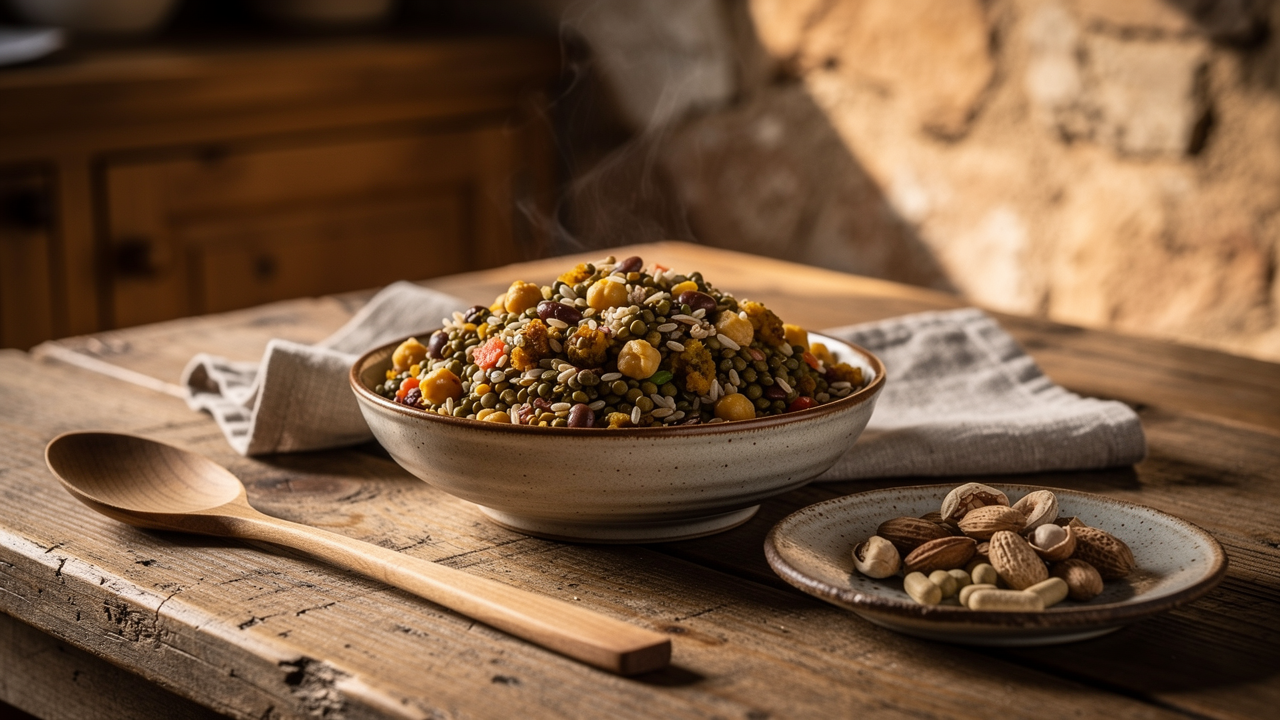
The evidence names legumes and grains and grain-based products as rich dietary zinc sources in European diets, and the NIH notes that vegetarians and vegans may have more difficulty meeting zinc needs because they exclude meat and eat more phytate-rich plant foods (EFSA scientific opinion; NIH consumer fact sheet). The practical takeaway is to make zinc-containing plant foods a daily pattern, not a one-meal fix.
| Diet pattern factor | What the evidence says |
|---|---|
| High-phytate plant staples | EFSA says phytate in the duodenum and jejunum can have a major impact on how much zinc is available for absorption, and diets with a phytate-zinc molar ratio above about 15 were classified as low in absorption efficiency (EFSA scientific opinion). |
| Mixed plant-based meals | At phytate-zinc molar ratios between 5 and 15, absorption is less efficient than in low-phytate diets (EFSA scientific opinion). |
| Lower-phytate preparation | A trivariate model found that dietary zinc and phytate content explained more than 80% of the variability in absorbed zinc (PubMed: zinc bioavailability and homeostasis). |
Use preparation methods that lower phytate
Controlled fermentation, including sourdough and fermented legumes, can degrade phytate through endogenous or microbial phytase, and human intervention evidence found that phytase supplementation or dephytinized foods improved zinc bioavailability in most studies, with positive findings in about 79% to 82% of trials (PubMed: fermentation of food and feed; PubMed: phytic acid, dephytinization, and phytase supplementation).
Keep the pattern food-first
Plant-based diets are not automatically poor in zinc; they usually just need more attention to food choice and preparation because phytate lowers absorption. A food-first plan means repeating zinc-containing plant foods across the day, choosing fermented or leavened breads when available, and using soaking or sprouting when practical so the overall pattern is less phytate-heavy.
Key takeaway: Plant-based eaters can cover zinc from food, but the evidence shows that phytate makes the pattern work best when zinc-containing foods are eaten regularly and prepared to reduce phytate.
What are the safety limits and interaction risks?
The main safety limit for zinc is a tolerable upper intake level (UL), which is the highest chronic daily intake unlikely to pose a risk. The NIH Office of Dietary Supplements sets the adult UL at 40 mg/day of total zinc from all sources, with age-stratified ULs for infants, children, and adolescents ranging from 4 to 34 mg/day. EFSA’s Scientific Committee on Food set an adult UL of 25 mg/day. These limits are not targets; they are ceilings for total intake, and they matter most when zinc is stacked from supplements, medicines, or other zinc-containing products on top of food.
| Authority | Adult UL | Children and adolescents | What the limit means |
|---|---|---|---|
| NIH ODS | 40 mg/day | 4 to 34 mg/day | Total zinc from food, beverages, supplements, and medications |
| EFSA / SCF | 25 mg/day | ULs were also set for younger life-stage groups in the opinion | The UL is not a recommended intake |
What too much zinc can feel like
At high intakes, the NIH fact sheet lists nausea, vomiting, dizziness, headaches, loss of appetite, and gastrointestinal distress as signs of excess zinc. With longer-term intake, 50 mg/day or more for weeks can impair copper absorption, reduce immune function, and lower HDL cholesterol; very high intakes may also disturb magnesium balance. NIH ODS
The UL is the maximum chronic daily intake unlikely to pose a risk; it is not a recommended level. EFSA / SCF
Medicine timing matters
Zinc can interfere with some medicines, and some medicines can change zinc status. The NIH consumer fact sheet says quinolone and tetracycline antibiotics should be separated from zinc because taking them together can reduce absorption of both; it advises taking zinc at least 2 hours before or 4 to 6 hours after these antibiotics. For penicillamine, zinc should be taken at least 1 hour apart. The same source also notes that thiazide diuretics can increase zinc excretion. NIH ODS
Who needs extra caution
Higher-risk groups include people who use high-zinc products long term, people with gastrointestinal disorders or other causes of poor absorption, those after bariatric surgery, and anyone using denture adhesives that contain zinc. The NIH consumer fact sheet also flags older adults and vegetarians or vegans as groups in whom zinc intake can be a concern. NIH ODS NIH ODS
What are the most common zinc-source mistakes?
Counting one food or one day
People often judge zinc by a single meal, but zinc status is not read that way. The NIH notes that serum or plasma zinc can stay in the normal range of about 80–120 µg/dL even when intake is low, and that these biomarkers shift with age, sex, time of day, infection, hormones, or illness NIH ODS zinc fact sheet. In the same fact sheet, zinc requirements are described as life-stage dependent, so a short food diary can miss needs that change across pregnancy, infancy, or older age NIH ODS zinc fact sheet.
A second issue is that self-reported intake is easy to overestimate. The NIH says dietary surveys rely on self-report, and the mix of zinc-containing foods across several days matters more than one isolated eating pattern NIH ODS zinc fact sheet.
Ignoring phytate and treating all zinc as equal
Phytate is the main dietary inhibitor of zinc absorption, and it is common in plant foods PubMed: zinc bioavailability and homeostasis. EFSA’s draft opinion categorises diets with a phytate:zinc molar ratio above about 15 as low-absorption diets, while ratios between 5 and 15 are less efficient than lower-phytate diets EFSA Scientific Opinion on Dietary Reference Values for zinc. That means two menus with the same zinc content can deliver different amounts to the body PubMed: zinc bioavailability and homeostasis.
Dietary protein does help, but not in a way that cancels phytate. A recent PubMed review reports that proteins, peptides, and amino acids can enhance zinc bioavailability, while phytate still lowers absorption PubMed: dietary Zn bioaccessibility and bioavailability.
Reading labels as if the salt weight were the zinc weight
| Label wording | What it means | Common mistake |
|---|---|---|
| Zinc sulfate, zinc acetate, zinc gluconate | These are common supplement forms listed on labels NIH ODS zinc fact sheet | Thinking the compound name is the dose |
| Elemental zinc | The Supplement Facts panel states the amount of elemental zinc, not the full compound weight NIH ODS zinc fact sheet | Comparing products by salt weight instead of elemental zinc |
The NIH also reports that zinc citrate and zinc gluconate are about 61% absorbed in young adults, while zinc oxide is about 50% absorbed, so the form can matter after the elemental amount is checked NIH ODS zinc fact sheet.
Letting supplements replace the food pattern
Supplements can add zinc, but they do not change a low-zinc food pattern by themselves. The NIH consumer fact sheet says vegetarians and vegans may have trouble meeting zinc needs because they exclude meat and eat more phytate-rich plant foods; the same fact sheet also flags older adults, people with gastrointestinal disorders, and people using denture adhesives as groups where intake can be too low or too high NIH ODS consumer fact sheet.
The main error is not one supplement choice; it is assuming the whole day’s zinc picture is clear from one food, one label, or one tablet.
For shoppers, the practical check is simple: look at the whole pattern, not just one source, compare elemental zinc rather than salt weight, and remember that phytate-rich menus can make the same stated zinc amount less available for absorption EFSA Scientific Opinion on Dietary Reference Values for zinc NIH ODS zinc fact sheet.
Safety and precautions
The adult upper limit noted in the body is 40 mg/day from all sources in the NIH framework, and 25 mg/day in the EFSA/SCF framework; these are ceilings, not goals. Higher intakes can cause nausea, vomiting, dizziness, headaches, loss of appetite, and gastrointestinal distress, and long-term high intake can impair copper absorption.
Ask a healthcare professional before using zinc with antibiotics or penicillamine, and get advice before use in pregnancy, lactation, or for children. Extra caution is also noted for people with gastrointestinal disorders, after bariatric surgery, and for anyone using denture adhesives that contain zinc.
Frequently asked questions
Which zinc-rich foods are best if I do not eat shellfish?
If you are avoiding shellfish, the body points to beef, cheddar cheese, pumpkin seeds, fortified breakfast cereal, whole wheat bread, lentils, and Greek yogurt as useful options. Legumes and grains also contribute, but their zinc may be less available when the meal is high in phytate. The practical idea is to spread zinc-containing foods across the day rather than rely on one food alone.
Do fortified breakfast cereals count as reliable zinc sources?
Yes, they can count as useful sources because a typical serving provides about 2.8 mg of zinc in the body’s comparison. The exact amount depends on the product and how much fortification it has. They are best treated as a convenient source that still needs label checking.
Is zinc from beans as useful as zinc from meat?
Not always. Beans contain zinc, but plant foods also tend to contain phytate, which lowers absorption. Meat is often more efficiently used in the body because the overall meal context is different and animal protein can help.
Can soaking or sourdough bread improve zinc availability?
Yes. The body says controlled fermentation, including sourdough and fermented legumes, can degrade phytate, and soaking or sprouting can also reduce it. That can make the same zinc content more available for absorption.
Should I choose zinc citrate, zinc gluconate, or zinc picolinate?
The body directly compares citrate, gluconate, and oxide, and notes similar absorption for citrate and gluconate in young adults. It does not give a direct comparison for picolinate here. The safest way to compare products is to check elemental zinc per serving first, then serving size and daily-use instructions.
How can I tell whether a supplement label lists elemental zinc?
Look at the Supplement Facts panel, because it lists the amount of elemental zinc rather than the full compound weight. For example, a line such as "15 mg zinc (as zinc gluconate)" means 15 mg of zinc in the serving. Compare the elemental amount per serving, not the salt name alone.
Sources
- Zinc - Health Professional Fact Sheet (external link)
- Zinc bioavailability and homeostasis - PubMed (external link)
- Dietary Phytic Acid, Dephytinization, and Phytase Supplementation Alter Trace Element Bioavailability-A Narrative Review of Human Interventions - PubMed (external link)
- Fermentation of food and feed: A technology for efficient utilization of macro and trace elements in monogastrics - PubMed (external link)
- Dietary Zn-Recent Advances in Studies on Its Bioaccessibility and Bioavailability - PubMed (external link)
- Scientific Opinion on Dietary Reference Values for zinc (external link)
- Zinc - Consumer (external link)
- complet_chapitres.indd (external link)
- USDA National Nutrient Database-Zinc (external link)